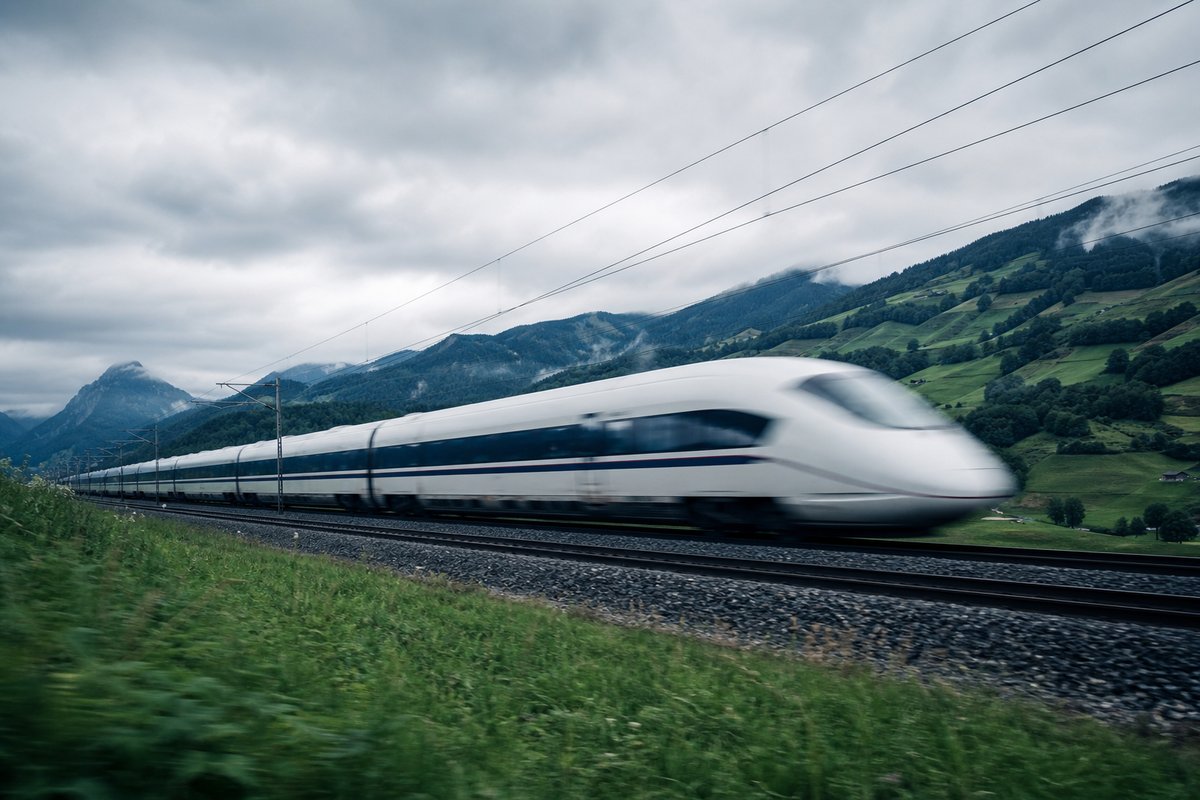
Europe's high-speed rail network is the largest outside China, connecting major cities at speeds of 250–350 km/h. Spain leads in total network length, France in operational maturity, Germany in cross-country coverage, and Italy in recent rolling stock innovation. Behind the headline speeds, the infrastructure challenges are significant: building new lines in densely populated countries is expensive and politically complex, cross-border interoperability requires a common signalling standard that is still being phased in, and the economics of high-speed rail depend heavily on national subsidy structures and passenger demand patterns.
Defining High-Speed Rail
The EU defines high-speed rail as rail lines designed or upgraded for 200 km/h or above, with purpose-built high-speed lines targeting 250 km/h or above. In practice, the industry distinguishes between purpose-built high-speed lines (LGV in France, Neubaustrecke in Germany, LAV in Spain, AV in Italy) and upgraded conventional lines capable of 200 km/h. Most operational HSR runs at 300–320 km/h in commercial service.
Speed is a function of infrastructure: a train designed for 400 km/h can only achieve that on track built to the corresponding alignment standards — long curve radii, precise gradient controls, sophisticated overhead catenary, and dedicated signalling. The Frecciarossa 1000, certified at 400 km/h, operates commercially at 300 km/h because existing Italian line infrastructure is engineered to that limit.
The Major Networks
France: LGV and the TGV Family
France's réseau à grande vitesse comprises approximately 2,800 km of LGV (Ligne à Grande Vitesse), with Paris at the hub of a star-shaped network. The LGV Sud-Est (Paris–Lyon, 1981) was the first operational HSR line in Western Europe. The current system radiates from Paris to Lyon, Marseille, Bordeaux, Nantes, Strasbourg, and via the Channel Tunnel to London. The TGV Duplex, a double-deck train, maximises capacity on the densest routes.
SNCF's April 2007 record run of 574.8 km/h on the LGV Est remains the world speed record for a conventional wheeled train. The test used a specially modified TGV set on straight track with reduced passenger load and boosted catenary voltage — not replicable in commercial operation, but a demonstration of the technology's theoretical ceiling.
Spain: AVE and the Widest Network
Spain's Alta Velocidad Española (AVE) network exceeds 4,000 km, the longest in Europe and second only to China globally. Spain chose to build its HSR on standard gauge (1,435 mm) rather than the historical Iberian gauge (1,668 mm), making future cross-border interconnection with France and Portugal straightforward. The Madrid–Barcelona corridor (620 km) is the busiest HSR route in Europe by passenger numbers, carrying over 4 million passengers per year. Operational speeds on the newest sections reach 310 km/h.
Germany: ICE and Mixed Infrastructure
Germany's Intercity-Express (ICE) network operates on a combination of purpose-built Neubaustrecken (new lines, 250–300 km/h) and upgraded Ausbaustrecken (enhanced lines, 200 km/h). The total high-speed line length is approximately 1,600 km of NBS, but the ICE serves a wider geographic network because trains operate onto conventional lines for final approaches to city centres. The ICE 3neo (BR 408) is the current flagship, operating at 320 km/h on the latest NBS sections.
Italy: Frecciarossa and the AV Network
Italy's Alta Velocità (AV) network connects Turin, Milan, Florence, Rome, Naples, and Salerno. The Frecciarossa 1000, built by Hitachi and Bombardier, is certified at 400 km/h under controlled conditions — the highest certification for any commercial HSR train in Europe. The operator Trenitalia competes on the Milan–Rome corridor with NTV Italo (AGV derivative), making this route one of the few HSR markets with direct commercial competition.
TEN-T and the EU Network Target
The revised TEN-T Regulation (EU) 2024/1679 establishes legally binding completion dates for the European transport network. The Core Network — the 9 major European corridors — must be complete by 2030. For rail, this means standardised track gauges, electrification, ERTMS deployment, and minimum line speeds of 160–200 km/h across all Core Network rail segments.
The Extended Core Network has a 2040 deadline, and the Comprehensive Network 2050. In rail terms, achieving the 2030 target requires significant infrastructure investment in central and eastern European member states, where HSR infrastructure is least developed. Poland's Central Communication Port (CPK) project envisages a major new HSR hub and associated new lines radiating across the country, with the first sections targeted for the 2030s.
ERTMS: Solving the Interoperability Problem
A train running from London to Madrid historically required up to four different onboard safety systems — the UK's ATP/TPWS, the French TVM, the Spanish ASFA, and the Spanish LZB equivalent. This interoperability barrier adds cost, limits rolling stock cross-border use, and constrains the expansion of cross-border services.
ERTMS comprises two elements: ETCS (European Train Control System) for continuous onboard safety supervision, and GSM-R (and its successor FRMCS, Future Railway Mobile Communication System) for voice and data radio. ETCS Level 2 enables cab signalling — the driver's display shows permitted speed and distance to next restriction, eliminating the need for lineside signals and enabling moving-block operation (Level 3) that increases capacity without additional infrastructure.
Full ERTMS deployment on all TEN-T Core Network lines is a 2030 TEN-T obligation, though deployment progress across member states varies significantly. France, Germany, and the UK have large portions of legacy infrastructure to retrofit alongside new-line installations.
Speed Records in Context
| Year | Record | Train | Location |
|---|---|---|---|
| 1981 | 380 km/h (test) | TGV PSE | France — LGV Sud-Est |
| 1990 | 515 km/h (test) | TGV Atlantique | France — LGV Atlantique |
| 2007 | 574.8 km/h (test) | TGV POS | France — LGV Est |
| 2015 | 400 km/h (cert.) | Frecciarossa 1000 | Italy — commercial certification |
| 2024 | 320 km/h (service) | ICE 3neo (BR 408) | Germany — NBS Frankfurt–Köln |
Environmental Case for HSR
High-speed rail's energy consumption is substantially lower than aviation on a per-passenger-kilometre basis. SNCF data for the TGV shows approximately 1.7 g CO₂/passenger-km (including upstream electricity generation) versus 150–200 g for short-haul aviation. The comparison is most favourable where the grid electricity is low-carbon — France's nuclear-dominant grid and the Nordic hydro-dominant grid make rail substantially cleaner than the EU average.
EU regulation has moved incrementally toward favouring rail over short-haul aviation. France's ban on domestic flights where a rail alternative of 2.5 hours or less exists (effective 2023) covers Bordeaux–Paris, Lyon–Paris, and Nantes–Paris. Austria's night train revival and partnerships between Eurostar, Deutsche Bahn, and SNCF target further modal shift on cross-border medium-distance routes.
Frequently Asked Questions
What speed qualifies a train as high-speed?
The EU defines high-speed rail as lines designed for 250 km/h or above on purpose-built track. The UIC categorises Category I lines at 250 km/h or higher and Category II at 200 km/h on upgraded track. Most modern HSR services operate at 300–320 km/h in regular service.
What is the fastest train in commercial service in Europe?
France's TGV holds the world record for a conventional wheeled train at 574.8 km/h (April 2007, test run on LGV Est). In commercial service, TGV and Eurostar operate at 300–320 km/h. The Frecciarossa 1000 is certified at 400 km/h but operates commercially at 300 km/h on existing Italian network infrastructure.
What is the TEN-T network and how does it relate to high-speed rail?
TEN-T (Trans-European Transport Network) is the EU's infrastructure framework connecting member states. The revised Regulation (EU) 2024/1679 requires the Core Network to be complete by 2030. For rail, this means all Core Network passenger lines must accommodate at least 160–200 km/h, forming an HSR-compatible backbone across the EU.
What is ERTMS and why is it important for European high-speed rail?
ERTMS (European Rail Traffic Management System) replaces approximately 20 incompatible national train protection systems with a single standard. ETCS (the onboard control component) and GSM-R/FRMCS (radio communication) enable a train to cross borders without changing onboard safety equipment. Deployment across the TEN-T Core Network is a 2030 obligation.
Which European countries have the most developed high-speed rail networks?
Spain leads in network length (4,000+ km), France in operational maturity (LGV since 1981, TGV world speed record), Germany in geographic coverage (ICE network, ~1,600 km NBS), and Italy in rolling stock innovation (Frecciarossa 1000, certified 400 km/h). Switzerland's conventional network achieves de-facto HSR frequencies without dedicated new lines.
How does high-speed rail compare to aviation for medium-distance travel?
For journeys of 500–800 km, HSR is competitive with aviation on total city-centre-to-city-centre journey time and significantly better on carbon footprint — approximately 1.7 g CO₂/passenger-km for TGV versus 150–200 g for short-haul aviation. France has banned several domestic flights where a rail alternative of 2.5 hours or less exists. Above 1,000 km, aviation typically wins on elapsed time.
Published: