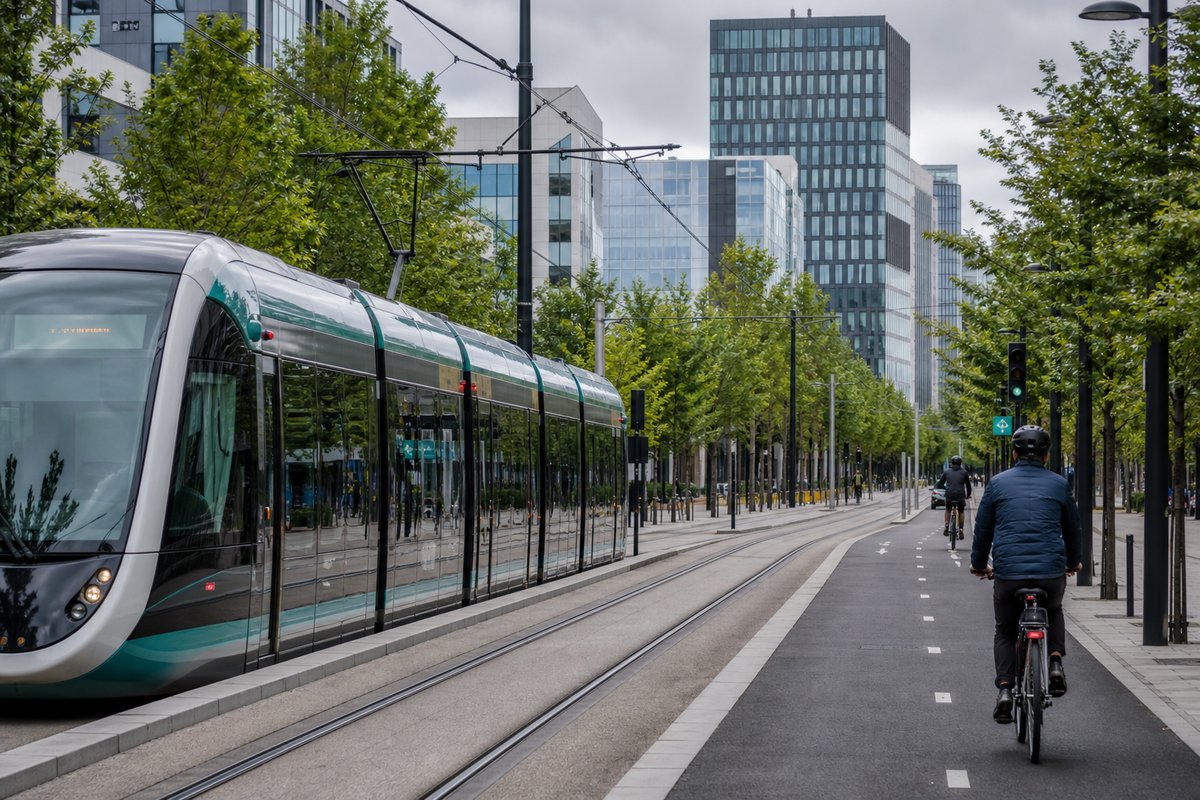
More than 75% of Europeans live in urban areas, and the systems that move them — roads, railways, buses, bicycles, and increasingly autonomous vehicles — are under simultaneous pressure from growth, climate policy, and digital transformation. Urban mobility is no longer just a transport engineering question; it sits at the intersection of urban planning, environmental policy, and data technology. This article surveys the key developments reshaping how European cities handle movement.
The Urban Mobility Challenge
European cities face a structural tension between growing travel demand and the finite capacity of urban space. Road widening is no longer viable in most historic city centres, and suppressed demand means that new road capacity is typically filled within years of opening. The dominant policy response across Europe is demand management — making private car use more expensive in congested areas — combined with investment in alternatives.
The environmental dimension adds urgency. Road transport accounts for approximately 15% of EU CO2 emissions. The EU's Fit for 55 package and the 2035 deadline for ending new internal combustion engine car sales are accelerating the electrification of private and commercial fleets, while Euro 7 emissions standards tighten requirements for residual pollutants.
Electric Vehicles: Adoption and Infrastructure
Battery electric vehicle (BEV) registrations reached approximately 14–15% of new car sales in the EU in 2024. Norway, buoyed by a comprehensive incentive structure, leads global EV adoption with over 85% of new registrations being BEVs. Germany, France, and the Netherlands are the largest markets by volume. The EU has committed to removing new internal combustion engine sales from 2035, though ongoing debate about e-fuel exceptions continues.
The critical enabler for further EV adoption is charging infrastructure. The Alternative Fuels Infrastructure Regulation (AFIR) requires EU member states to deploy public fast chargers (minimum 150 kW) at regular intervals on the Trans-European Transport Network. By 2025, Europe had over 750,000 public charging points — with distribution concentrated in the Netherlands, Germany, and France — but rural charging density remains a barrier in southern and eastern member states.
| Standard | Type | Max power | Usage |
|---|---|---|---|
| Type 2 (IEC 62196) | AC | 22 kW | Home / workplace charging |
| CCS2 (Combo 2) | DC fast | 350 kW | Public fast charging; EU standard |
| CHAdeMO | DC fast | 100–400 kW | Older EVs; being phased out in Europe |
| NACS (Tesla) | AC + DC | 250 kW | Tesla-native; US standard adoption growing |
Autonomous Vehicles: Current State
Autonomous vehicles are categorised on the SAE International J3016 scale from Level 0 (no automation) to Level 5 (full automation, no human required). As of 2025, commercially deployed autonomous systems in Europe operate at Level 4 — capable of full autonomy within a defined operational design domain (ODD) — typically low-speed, geofenced environments such as campus shuttles, port logistics, and some urban transit routes.
Paris operates driverless metro lines (Ligne 1 and Ligne 14) at full capacity, as do Copenhagen and Nuremberg on their fully automated metro systems. On-road autonomous vehicle trials are conducted in several European cities under controlled conditions; deployment without a safety driver in public urban environments remains limited by regulatory frameworks and public liability questions. The EU AI Act, which came into force in 2024, classifies certain autonomous vehicle systems as high-risk AI, requiring conformity assessment before deployment.
Micro-mobility: E-Bikes and E-Scooters
Shared e-scooters and e-bike services have spread rapidly across European cities since 2018. Operators including Lime, Tier, and Voi collectively manage hundreds of thousands of vehicles across dozens of cities. Their reception has been uneven: Paris withdrew from a city-run shared e-scooter scheme in 2023 following a public referendum, while other cities have integrated micro-mobility into their wider MaaS ecosystems.
Private e-bike adoption has been more consistently positive. The Netherlands — where cycling has deep cultural roots — has over 23 million bicycles for 17 million people, with e-bikes now accounting for over half of new bicycle sales. Germany has seen similar trends, with e-bikes surpassing conventional bicycles in annual sales revenue since 2020. The combination of urban cycling infrastructure investment and longer e-bike range is extending the viable cycling catchment area in cities with challenging topography.
Smart Public Transit
Modern public transit systems generate enormous quantities of operational data. Automatic Vehicle Location (AVL) systems track every vehicle in a fleet in real time; passenger counting systems monitor load; ticket validation data records boarding patterns. Cities that expose these feeds publicly — via GTFS-RT (General Transit Feed Specification — Real Time) — enable third-party journey planners such as Google Maps, Apple Maps, and local apps to provide real-time arrival information.
Dynamic headway management systems adjust service frequency in real time based on passenger demand and current vehicle spacing, reducing the bunching problem that afflicts high-frequency bus routes. Transport for London's iBus system, deployed across over 8,000 vehicles, is among the most advanced bus control systems in Europe, enabling continuous route management from a central operations room.
Mobility as a Service
Mobility as a Service (MaaS) aims to integrate all transport modes — public transit, ride-hailing, bike share, e-scooters, and car rental — into a single platform for planning, booking, and payment. Whim (originally Helsinki) and Jelbi (Berlin's BVG-operated MaaS platform) are the most developed European examples. The value proposition is that bundling modes reduces the practical inconvenience of not owning a car for those who live in well-served urban areas.
MaaS faces a structural challenge: public transit operators are reluctant to distribute their ticketing revenue through third-party platforms, and private mobility operators have commercial interests that do not always align with system-wide optimisation. Regulatory frameworks that require open data and interoperability — such as the EU Delegated Regulation on multimodal digital mobility services — aim to address these tensions.
Frequently Asked Questions
What is urban mobility?
Urban mobility refers to the systems, infrastructure, and technologies that enable people and goods to move through cities. It encompasses road transport, public transit (metro, tram, bus), cycling and walking infrastructure, and emerging modes such as e-scooters, electric cargo bikes, and autonomous vehicles. Mobility-as-a-Service platforms integrate these modes into unified booking and payment systems.
What is the current state of electric vehicle adoption in Europe?
In 2024, battery electric vehicles (BEVs) accounted for approximately 14–15% of new car registrations across the EU. Norway leads global EV adoption with over 85% of new registrations being BEVs. Germany, France, and the Netherlands are the largest EV markets by volume. The EU's 2035 deadline for ending sales of new internal combustion engine cars continues to drive fleet electrification across member states.
What is Mobility as a Service (MaaS)?
Mobility as a Service (MaaS) integrates multiple transport modes — public transit, ride-hailing, bike share, e-scooters, and car rental — into a single digital platform for planning, booking, and payment. Whim (Helsinki) and Jelbi (Berlin) are European MaaS platforms that allow users to access various transport options through one app. MaaS aims to reduce private car dependency by making multi-modal travel as convenient as driving.
Are autonomous vehicles operating in European cities?
Limited autonomous vehicle deployments are operational in European cities, typically at SAE Level 4 in geofenced, low-speed environments. Examples include Navya and EasyMile autonomous shuttles in several French cities, and fully automated driverless metro lines in Paris, Copenhagen, and Nuremberg. Full SAE Level 5 autonomy — capable of operating without human supervision across all conditions — is not yet commercially deployed anywhere in Europe.
What is the 15-minute city concept?
The 15-minute city is an urban planning concept proposing that all daily needs — work, shopping, education, healthcare, recreation — should be reachable within 15 minutes by walking or cycling from any point in the city. Paris has pursued this concept under Mayor Hidalgo, including expanded cycling infrastructure, car-free zones, and greenification of major streets. The concept prioritises local accessibility over metropolitan speed.
How are European cities reducing traffic congestion?
European cities are using a range of measures: congestion pricing (London, Stockholm, Milan), low emission zones (LEZs) that restrict older polluting vehicles, expansion of cycling infrastructure, improvements to public transport frequency and reliability, and smart parking systems that reduce circling. The most effective schemes combine demand management with high-quality alternatives.
Published: